The Impact of Stellar Flares on Exoplanet Atmospheres
My current research at the University of Florida with Dr. Jason Dittmann focuses on finding stellar flares in data from the Transiting Exoplanet Sattelite Survey (TESS) mission.
Stellar flares may have a significant impact on planetary atmospheres, especially for exoplanets orbiting near their host stars. Detecting flares in the light curves of planet-hosting stars could tell us more about the presence or erosion of their planets' atmospheres, and will help us learn more about the consequences of stellar flares on planet habitability. Additionally, flares and other stellar activity can contaminate the transmission spectra of exoplanet atmospheres. Finding the flaring occurrence of stars with confirmed planets can provide insight into which targets warrant follow-up observations by JWST or other future missions investigating exoplanet atmospheres.
Young Exoplanet Detection
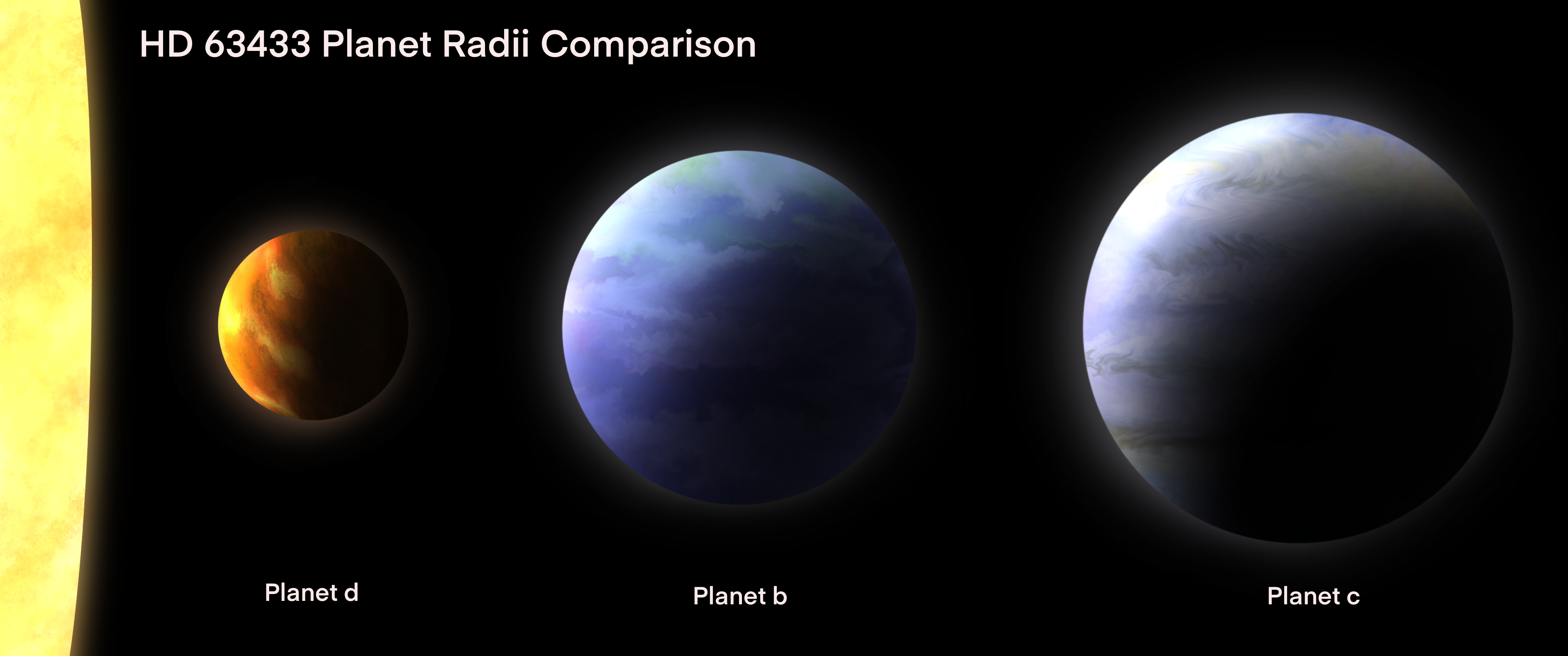
Our team recently detected and characterized the nearest Earth-sized exoplanet orbiting a Sun-like star, HD 63433 d. This newly-discovered world is the third planet found in this system, and it closely orbits its stellar host with a period of about 4 days. Notably, the host star is a member of a 400 Myr stellar association, making this triple-planetary system over 10x younger than our own solar system! Our team is working to better understand the physical/atmospheric properties of this young world. The publication I co-lead with Dr. Melinda Soares-Furtado is listed in my Publications section.
See the NASA discovery alert for our planet here, and my interview on the study here!
Dipper Stars
My collaboration and I published the largest catalog of Dipper Stars to date which you can find in my Publications section.
Dipper stars are a classification of young stellar objects that exhibit dimming variability in their light curves, dropping in brightness by 10-50%, likely induced by occultations due to circumstellar disk material. This variability can be periodic, quasi-periodic, or aperiodic.
These variable sources were found in a visual survey of TESS light curves, where dipping-like variability was observed. We found a typical age among our dipper sources of <5 Myr, with the age distribution peaking at ~2 Myr, and a tail of the distribution extending to ages older than 20 Myr. In our paper we presented the detection and characterization of the largest collection of dipper stars to date: 293 dipper stars, including 234 new dipper candidates. These dipper stars were part of our larger sample which in total made up a catalog of 414 young stellar variables.